2025-10-14 14:52 Tags:
📊 Dataset Overview
We use the Advertising dataset (from ISLR), showing:
-
sales— units sold (in thousands) -
TV,radio,newspaper— advertising spend (in thousands of dollars)
df = pd.read_csv("Advertising.csv")
df.head()
We create a new variable:
df['total_spend'] = df['TV'] + df['radio'] + df['newspaper']Then visualize:(that’s one way to know their relationship)
sns.scatterplot(x='total_spend', y='sales', data=df)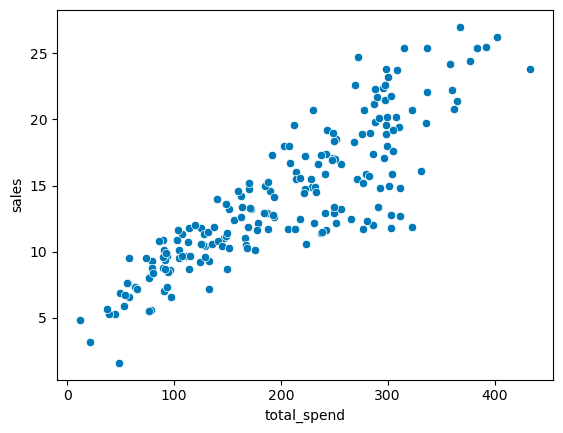
sns.regplot(x='total_spend',y='sales',data=df)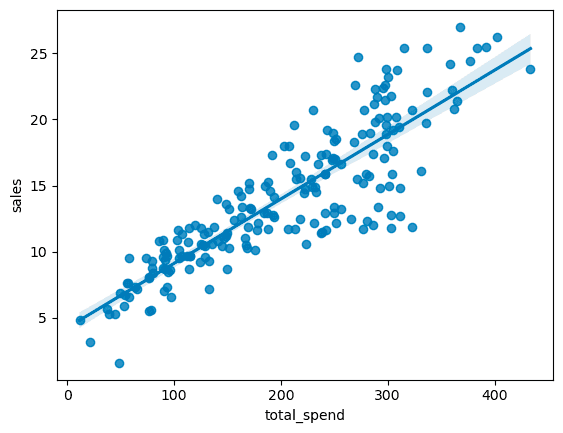
Is there a relationship between total advertising spend and sales?
📈 Least Squares Line
Using NumPy’s polyfit()
This is the function to solve beta0 and beta1
X = df['total_spend']
y = df['sales']

# Returns highest order coefficient first
np.polyfit(X, y, 1)
Example output:
array([0.04868788, 4.24302822])
So our regression line is:
🔮 Predicting Future Sales
If a future campaign has a total spend of $200k:
spend = 200
predicted_sales = 0.04868788 * spend + 4.24302822
predicted_sales
Result:
Predicted sales ≈ 14.98 (thousand units)
Visualize the line:
potential_spend = np.linspace(0, 500, 100) # in total 100 points
predicted_sales = 0.04868788 * potential_spend + 4.24302822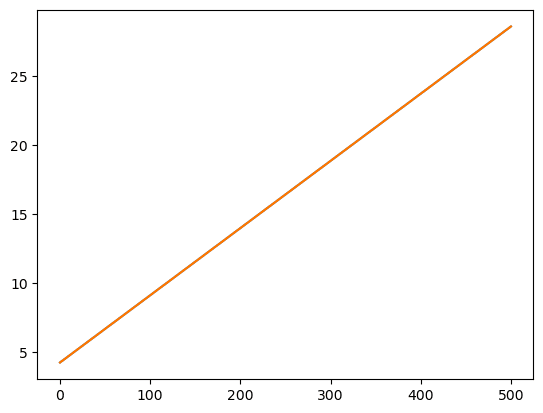
plt.plot(potential_spend, predicted_sales)sns.scatterplot(x='total_spend', y='sales', data=df)
plt.plot(potential_spend, predicted_sales, color='red')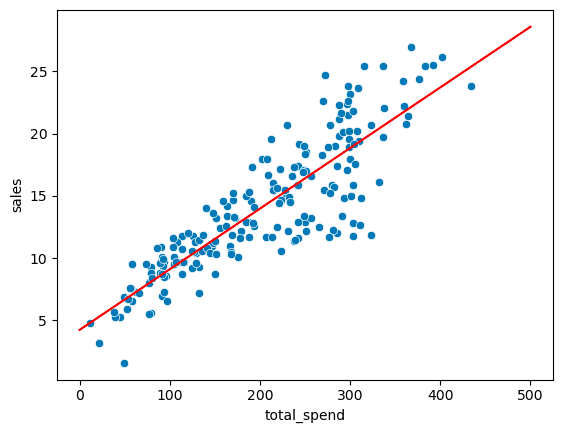
🔍 Model Fit and Complexity
We used a 1st-order polynomial (a straight line).
What happens if we try higher orders?
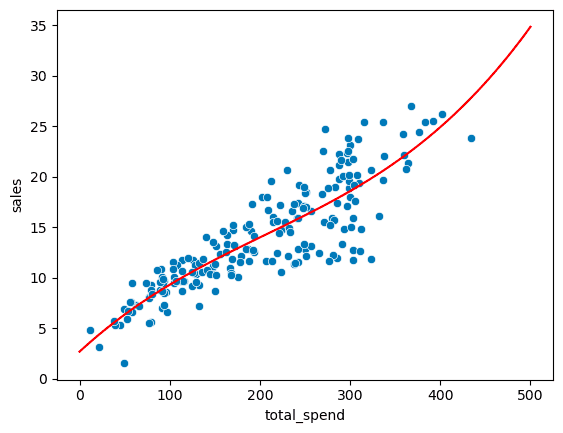
np.polyfit(X, y, 3)array([ 3.07615033e-07, -1.89392449e-04, 8.20886302e-02, 2.70495053e+00]) y = B3x** 3 + B2x ** 2 + B1x + B0 The coefficients are quite small, which means they have very small effects, so not very reasonable here.
Produces a cubic model:
predicted_sales = (
    3.07615033e-07 * potential_spend**3
    - 1.89392449e-04 * potential_spend**2
    + 8.20886302e-02 * potential_spend
    + 2.70495053
)sns.scatterplot(x='total_spend', y='sales', data=df)
plt.plot(potential_spend, predicted_sales, color='red')